GOOGLE REVIEWS

Following on from last week’s article regarding the change Google is making to their algorithm (BERT) we mentioned long-tail keywords, so I thought I would follow that up with more information about these specific types of keywords and searches.
What are long-tail keywords?
Every week, according to Google about 15% of searches on Google have never been seen before. These searches are highly specific and unique and Google is working hard to better handle these searches, so it can give visitors better answers.
These types of searches are often referred to as long-tail.
Long-tail keywords are search questions or queries users types into Google that are longer than 3 words and are specific in nature.
They are called long-tail keywords as they refer to the far end of the search graph. Generic keywords are short, broad in nature and highly used in search, but of course difficult to rank for because they are so popular. As we travel down the graph the search terms get longer and more specific and also easier to rank for.

As businesses, we can target these niche keywords to better serve and attract the right kind of clients to our business. I’ll explain.
Why target long-tail keywords?
Traditionally in SEO, companies have gone for the main keyword, eyeing the prize of thousands or hundreds of thousands of searches a month. This has, of course, increases competition and many large companies spend huge sums of money every month competing to stay at the top of the search results for those generic keywords.
As a smaller business or niche business, this is not a good strategy to follow. We have different priorities and don’t need or want thousands of enquiries a month. Plus we cannot afford the huge sums of money to complete it successfully.
As you can imagine as the keywords get more specific, further down the graph (see above) the search quantity dwindles, but as a smaller business, there is still enough for us to work on and get results from, as we can target our ideal client specifically.
Lower Costs
Long-tail keywords come with lower costs compared to the more popular generic keywords. This comes with the added bonus of lower competition as the search volume is lower. Also as these terms are more specific (and as long as you choose the right ones) they are better converting.
Enjoying This Article?
Never miss another one...
Sign up for our e-mail newsletter and we'll let you know when we publish new pieces like this to help you on your marketing journey.
Think about your customer’s journey, from their first initial idea of buying your product or service through to signing on the dotted line. The questions get more specific the closer they get to the sale. Those more specific questions are your long-tail keywords. The closer they are to the end of your funnel the closer the prospect is to buying from you and the better converting they will be.
Better Generic Ranking
As the long-tail keywords often contain the generic keyword, they help you rank for that as well. Now you will still be a long way away from coming top of the search results in the UK for a generic search result, but you may find yourself ranking favourably locally for that generic keyword. Especially if you write enough long-tail keyword articles/videos/presentations around the generic keyword.
Fit into Content Marketing
As mentioned above to rank for the long-tail keyword you have to produce content. Divulging your expertise around that subject or answering that question. This, of course, fits perfectly into your blog and social media.
By choosing highly relevant long-tail keywords you can produce articles/videos/presentations that create a wide range of content for your blog, which in turn can be shared on social media. Making it easier for your ideal customers to find you not only on Google but on Facebook, Twitter, Instagram and Linkedin.
Also, they can be used within your sales process to educate, inform and build trust with potential clients. Demonstrating your expertise, knowledge and experience in dealing with their ‘unique’ situation. Of course, to you, their situation is not unique, but to them, you come across as the perfect match for their problem.
Great for Alexa, Google Home and Others
And with all this, let us not forget the current fast-growing trend – Voice search. With the rise of Alexa and Google Home, plus Siri and others on phones, voice search is here to stay, and in many circumstances a lot easier to use than desktop computers and Google.
Voice searches, again tend to be specific. It’s easier to be specific with voice search as that is the way we naturally talk. As the algorithms powering voice search learn more and become better at interpretation, having the specific answer on your website will drive more traffic and better engagement.
What are the correct long-tail keywords?
The correct long-tail keywords come down to understanding your customers and what your customers love above your product or service.
Think about the questions your customers ask you throughout your buying cycle. What is it they want to know about your product or services that are highly relevant to the way you do it. Think about each stage of discovery your potential buyer goes through and what they need to know to make an informed, educated decision. Provide information and education around those needs.
And most of all be true to your business. Don’t try and produce content about something that is not really relevant to your business. You will only attract the wrong people. You will spend time trying to deal with them, answering questions and managing them, for them to only not buy from you, as they are not your customer.
Tools to help you find long-tail keywords
Below are a few ideas on how to search for long-tail keywords to give you an idea of what is out there. The first 3 are available right now on Google.
Autocomplete Results
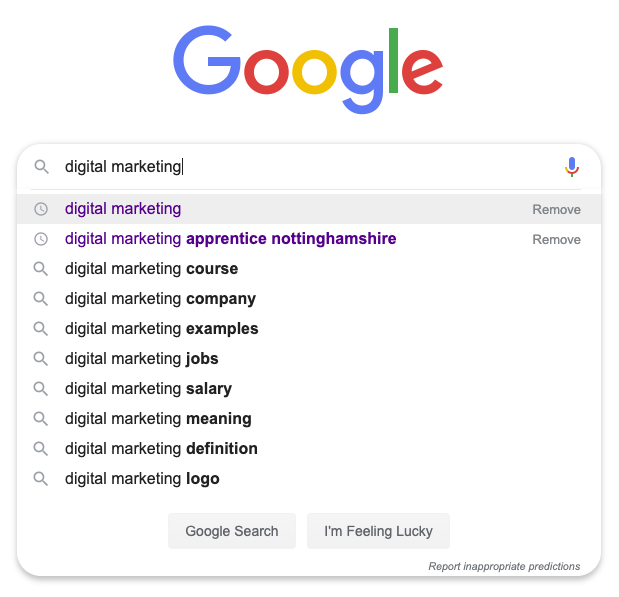
These you will have seen many a time. Start typing in a question into Google and it will offer up suggestions based on what other users have typed in. Take a look through the list. Are any relevant to you, you’re business or your services? Can you write or make a video to answer any of them?
People Also Ask
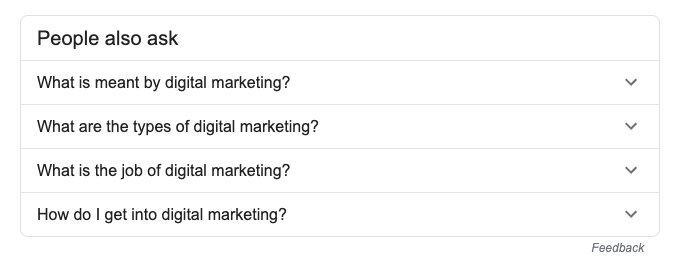
Once you have typed in a question or query. Look down the page of results and you will see a box titled ‘People also ask’. This box contains related searches to the one you have typed in. Clicking on one of these gives a snippet of an answer, but it also adds more questions to the list, based on the one you have clicked to open and view. Click on questions that you feel are most relevant and more relevant questions should appear.
Searches Related To
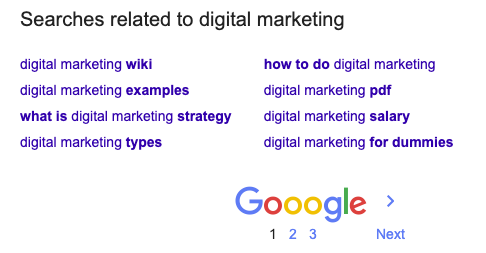
At the bottom of the Google search results page is the title ‘Searches related to…’. This again details further search queries related to your initial search. This is another source of a list of potential long-tail keywords.
Answer The Public
Is a free keyword research tool, done in an interesting and quirky way. https://answerthepublic.com allows you to enter a keyword or phrase and it will then go and collect a huge amount of data around that keyword. The results are split into 5 sections: Questions, prepositions, comparisons, alphabetical & related.
Each one can contain hundreds of ideas of long-tail keywords. Take a look and pick the ones relevant to your business and your customers.
There are more tools out there, some of which you can pay for, but these are good ones to start with to develop a better understanding of long-tail keywords.

Help with long-tail keywords
This is just a brief overview of long-tail keywords, just so you have a better understanding of how they work, why they are important and what they can do for you.
If you would like more help, then please give us a call or make an appointment. let us know what you need help with. We have helped many other businesses to rank in Google for terms specific to them.